
English| EUR
Suggested for you
More currencies
Choose a language
Riders arrive at Elephant Beach expecting scuba tanks and straps, and find neither. A sea scooter is closer to a bicycle with a bubble: battery, thruster, and a dome of air held over the head. Read this as a how does underwater scooter work guide — physics first, then the reef, then the practicalities that shape a Havelock Island water sports day.
Quick answer
An underwater scooter works like a seated electric tow: a battery-powered thruster pulls the rider forward while a clear dome over the head holds a pocket of air fed from a compressed-air cylinder, so breathing stays normal and hair stays dry. Sessions at Elephant Beach run daily between 09:00–15:00, with a 4,800 INR conservation fee per person.
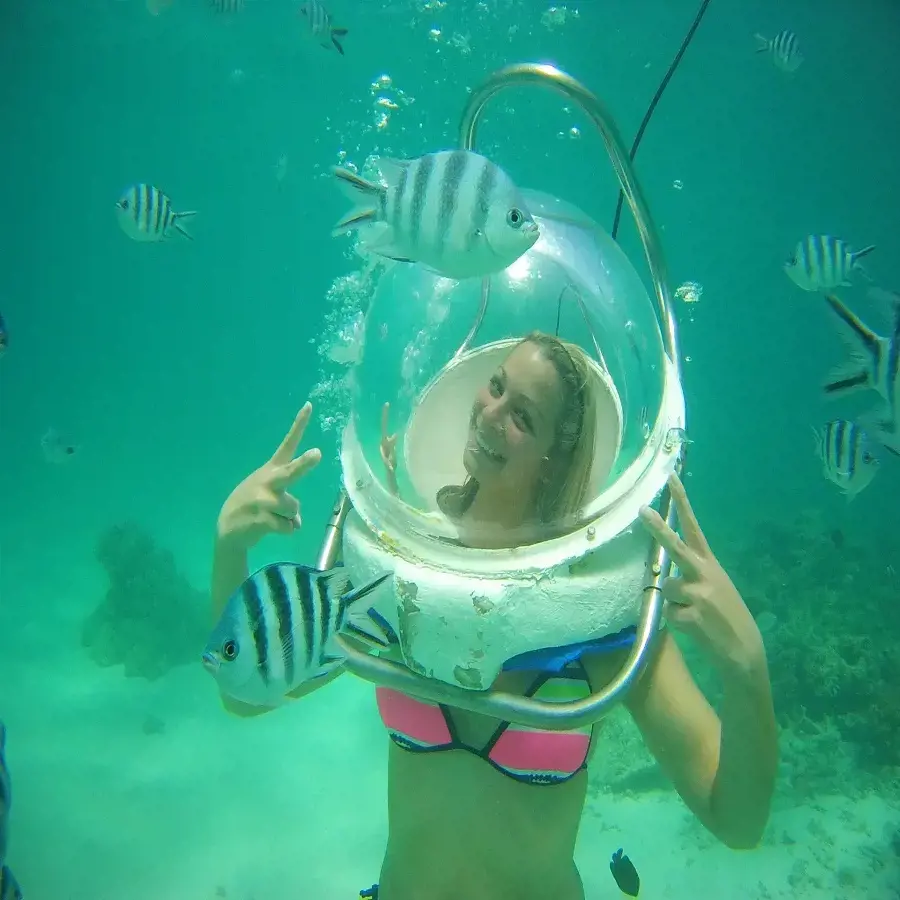
The principle behind the machine predates the aqualung by about four centuries. Sixteenth-century divers worked inside inverted bells, breathing air that water pressure held captive in the roof of the chamber. An underwater scooter borrows that geometry and shrinks it to the size of a motorcycle fairing. Strip away the marketing and how does underwater scooter work reduces to one sentence: a bubble that travels, pushed by a battery-driven thruster. Ballast weights do the rest, keeping the hull level against the lift of the trapped air. What matters at Elephant Beach is who the machine admits. Operators present a guided sea-scooter ride as an activity for non-divers; riders sit upright, hands on the handlebars, head sealed inside an acrylic dome fed from a compressed-air cylinder behind the seat. Hair stays dry. Glasses can be worn. An instructor rides alongside and controls the route, which is why the briefing on the boat matters more than any mechanical detail. Children and nervous first-timers tend to adapt within the first few metres of the sand channel. Geography explains the rest of the experience. Elephant Beach sits on the west coast of Havelock Island, known locally as Swaraj Dweep, behind a shallow reef flat that drops gently into the Andaman Sea. Visibility there is a function of sea state rather than season alone; calm water over pale sand returns light, and the coral bommies at the edge of the flat hold the fish life most riders come to see. The same shallow profile is what makes a पानी के नीचे स्कूटर feasible in the first place — the dome only works where the water stays within a narrow band of depth. Deeper reefs belong to scuba. For planning purposes, the mechanics answer one question and leave three open: when the water is clearest, what the conservation fee covers, and how long the boat transfer from the jetty takes. Those sit in the dedicated sections of this guide. Readers weighing an Elephant Beach underwater scooter tour against snorkelling or a sea walk should treat the three as variations on the same reef rather than competing attractions. Understanding how does underwater scooter work is simply the step that removes the hesitation, and the booking pages handle the rest.
“A bubble that travels, pushed by a battery-driven thruster — that is the whole machine.”
Underwater scooters rely on integrated electromechanical systems to facilitate propulsion and respiration while submerged. These devices combine battery-powered thrust with specialized air delivery to maintain a stable environment for the operator.
Underwater scooters utilize rechargeable battery packs to power electric motors, which drive a propeller to generate forward thrust for the vehicle. This propulsion allows the rider to move through the water column with minimal physical exertion.
The helmet system functions on a continuous flow principle, where compressed air is delivered from a surface-based source directly into the helmet. This constant supply maintains positive pressure inside the enclosure, which prevents water from entering the viewing area.
Engineers design these scooters with specific ballast configurations to ensure neutral or slightly positive buoyancy. This balance allows the unit to remain stable underwater while remaining manageable for the operator during descent and ascent.
The scooter chassis is shaped to minimize drag, allowing the propulsion system to operate efficiently at lower power settings. Streamlined fairings protect internal components while ensuring the vehicle remains maneuverable in various current conditions.
Because the rider's head remains enclosed in a dry environment, the air gap inside the helmet allows for standard voice communication between participants. This design feature maintains acoustic connectivity that would otherwise be lost when submerged.
Mechanisms are incorporated to allow for the immediate detachment of the scooter from the rider if necessary. These systems ensure that the operator can surface independently in the event of a mechanical failure or emergency.
The underwater scooter session at Elephant Beach follows a fixed sequence that takes you from dry-land briefing to piloting the unit along the reef and back to the boat. Most visitors move through the whole procedure in well under an hour, with the submerged portion forming only part of that.
Present your booking confirmation at the operator desk on the beach and fill in the medical declaration and consent form. Declare asthma, recent ear surgery, heart conditions or pregnancy here rather than mid-session, because disclosing later usually ends the dive before it starts.
Listen through the dry-land talk covering hand signals, the thumbs-up ascent signal and how the dome keeps your head in air. People tune out during the signal demonstration, then cannot tell the guide they are uncomfortable once underwater.
Sit still while staff lower the clear dome over your head and secure the shoulder harness and weight system. Keep your hair tied back and remove earrings and glasses beforehand, since loose items snag on the helmet seal.
Climb down the ladder and let the guide take your weight as the helmet becomes buoyant. Do not grab the scooter handlebars while still on the ladder; wait until you are stable at the surface.
Swallow or move your jaw as you sink to the seabed and tell the guide if your ears hurt. Pushing through ear pain instead of pausing causes most aborted sessions.
Hold the handlebars, use the throttle for forward movement and steer with gentle shoulder weight shifts. Beginners over-steer and chase the reef; small inputs and a slow pace keep the dome level and your view clear.
Follow the guide's signal, rise slowly beside the scooter and keep your head upright until staff lift the helmet clear. Standing up too early tips water into the dome.
Use the freshwater rinse point for mask-free skin and salt-covered gear, then collect any photos or video the guide recorded. Confirm the handover method before leaving the beach, as reception on the island is patchy.
The optimal time for an underwater scooter experience is between 09:00 and 14:00. This arrival window ensures exposure to peak water visibility and calmer sea conditions.
—
These hours provide the most consistent water clarity and calmest surface conditions for operation.
—
Conditions remain stable, though light refraction is highest, providing clear views of the reef.
24°C to 30°C
Lower humidity and calm seas create predictable conditions for underwater navigation.
28°C to 34°C
Warm water temperatures are frequent, though wind patterns can vary throughout the day.
Verdict: For the best experience, plan your arrival between 09:00 and 14:00 on any day from November through January to benefit from calm seas and clear visibility.
Underwater scooter sessions operate daily throughout the week. The facility maintains consistent hours for all scheduled activities.
The underwater scooter experience is located at Elephant Beach on Havelock Island, Andaman and Nicobar Islands, India. Visitors typically reach this location via a combination of road transport to the jetty followed by a boat transfer.
Taxi or hired vehicle to Havelock Jetty
Ferry from Havelock Jetty to Elephant Beach
Walking from the beach arrival point to the scooter launch site
Plan your arrival to the beach within the window of 09:00–14:00 to align with optimal visibility and calmer sea conditions. Ensure you have arranged your boat transfer from Havelock Jetty in advance as it is the primary access method.
Everything you need to know about how does underwater scooter work
The device operates using a battery-powered motor that propels a specialized helmet or pod, allowing you to cruise through the water column while breathing normally. By understanding how does underwater scooter work, participants can comfortably navigate the marine environment without complex equipment.
You do not need to be a strong swimmer because the buoyancy of the unit and the guidance of your instructor ensure you remain stable. This makes the underwater scooter activity accessible to those who are less confident in the open ocean.
The required conservation fee is 4,800 INR per person. This fee supports the preservation of the local marine habitat at Elephant Beach.
Safety is maintained through professional monitoring and a controlled propulsion system that keeps you moving at a steady pace. Learning how does underwater scooter work includes a briefing on simple controls that allow you to manage your direction and depth easily.
We recommend arriving between 09:00 and 14:00 to ensure you experience the best visibility and calmer sea conditions. These hours provide the clearest views of the reef and marine life.
Children can generally participate if they meet the height and age requirements set by the guides for safety. It is a family-friendly activity that helps younger participants learn how does underwater scooter work under direct supervision.
The scooters are designed for simplicity and ease of use, making them ideal for individuals with no prior diving experience. Because the design is intuitive, most guests feel comfortable after a brief orientation on the beach.